Your AI won't work without clean operations
AI doesn't fix messy processes. It amplifies them. The businesses getting real value from AI are the ones that sorted their operations first.
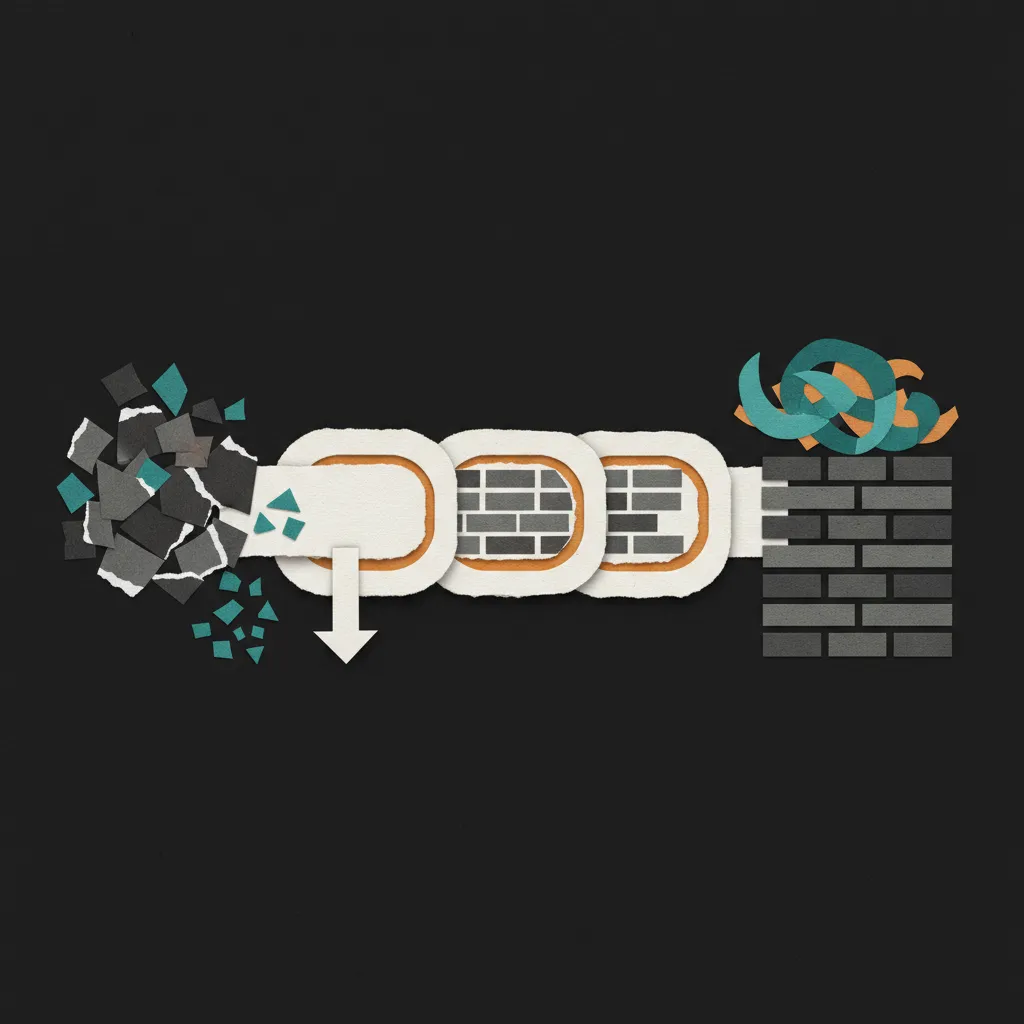
There’s a pattern that shows up in almost every failed AI project. The technology worked. The model was capable. The system was well designed. But the data going in was inconsistent, the process upstream was undefined, and the outputs were unreliable because the inputs were unreliable.
AI rarely fixes messy operations. More often, it processes them faster.
The amplification problem
AI systems are amplifiers. Whatever you feed them, they scale. If your data is clean, your processes are structured, and your inputs are consistent, AI will produce reliable, useful outputs at speed.
If your data is scattered across spreadsheets, your naming conventions change depending on who entered the record, and your process has three unofficial variations depending on which team member is handling it, AI is likely to produce three variations of the wrong answer at speed.
This is the part that gets overlooked in the excitement around adoption. The technology is rarely the bottleneck. More often, it’s the operations feeding it.
Where the mess usually lives
Inconsistent data. CRM records with missing fields. Client names spelled three different ways. Revenue figures in some reports but not others. AI can work with imperfect data, but there’s a threshold below which the outputs become meaningless.
Undefined handoffs. Work moves between people without a clear structure. One person finishes a task and emails it to someone else, who interprets it differently and passes it along again. By the time AI enters the picture, the input has been filtered through multiple assumptions.
Tribal knowledge. The process works because Sarah knows what to do. But what Sarah does isn’t written down anywhere. When you try to encode it into a system, you discover that the process doesn’t actually exist as a process. It exists as a person.
Multiple sources of truth. The forecast lives in a spreadsheet. The project status lives in someone’s head. The client brief is in an email thread from two months ago. AI works best with a single, reliable input source. If the business doesn’t have one, the system is likely to struggle too.
What “clean enough” looks like
You don’t need perfect data or flawless processes to use AI. You need them to be consistent enough that a system can rely on them.
Structured inputs. The data coming into the system follows a predictable format. (For more on what good system architecture looks like, see what an AI system actually looks like.) Fields are filled in. Naming conventions are consistent. If a human would struggle to interpret the input, AI will too.
Documented processes. Not a 40-page operations manual. A clear description of what happens, in what order, with what inputs and outputs. Enough structure that someone new could follow it without asking three colleagues for context.
Single sources of truth. One place for each type of information. The CRM is the CRM. The project tracker is the project tracker. When a system pulls data, it knows where to look and trusts what it finds.
Defined exceptions. Every process has edge cases. Clean operations don’t eliminate them. They account for them. The system knows what to do when a record is incomplete, when a client brief is missing, when an approval doesn’t come through.
The uncomfortable prerequisite
Cleaning up operations isn’t exciting. It’s not a technology project. It’s an organisational discipline project. It involves documenting workflows, standardising data entry, and getting people to use the same systems in the same way.
But it’s the prerequisite that makes everything else work. An AI system built on clean operations compounds value over time. An AI system built on messy operations risks compounding problems rather than solving them.
Start with the input, not the output
Before designing an AI system, look at what will feed it. Walk the process backwards from the desired output to the original data source. Every step in between is a potential failure point.
If the inputs are clean and consistent, the system will work. If they’re not, fix them first. It’s less glamorous than launching an AI project, but it’s the difference between a system that runs reliably and one that generates confident-looking nonsense. And if you’re not sure whether your operations are ready, our piece on how to know if your business is ready for AI covers the signals to look for.